THE CORE CONCEPT: TWO ENDS OF A VOCAL SPECTRUM
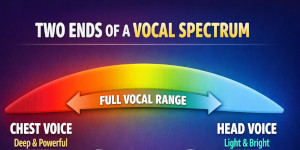
Your vocal cords are capable of vibrating in different ways to produce different qualities of sound. Mastering the coordination between these registers allows singers to access their full vocal range smoothly and without strain.
Key Insight:
Both registers are produced by the same vocal cords - they just vibrate differently. The transition between them is called your passaggio or "break."
CHEST VOICE: THE POWER REGISTER

Physical Sensation
You feel a strong vibration or resonance in your chest cavity and upper torso when you sing in this register. Place your hand on your chest and say "AH" loudly - that vibration is chest voice.
How It Works
Your vocal cords come together with a thick, full mass and vibrate across their entire length. It's like pressing down on the low strings of a guitar—you get a thick, powerful sound.
Sound Quality
Fuller, richer, heavier, and more direct. It has a conversational, powerful quality perfect for belting and strong emotional delivery.
Typical Use
Men: This is their dominant, comfortable range (most of a typical pop song verse).
Women: Their lower range, but often used powerfully in pop, rock, and musical theatre.
Examples
• Johnny Cash - "Hurt" (verse)
• Adele - "Rolling in the Deep" (powerful chorus)
• Sing "Hey!" loudly to get someone's attention
HEAD VOICE: THE AGILITY REGISTER

Physical Sensation
You feel the vibration and resonance in your head—specifically in your sinuses, cheekbones, and behind the nose/eyes (the "mask" of the face).
How It Works
Your vocal cords stretch longer and thinner, and they vibrate only along their edges. It's like playing a harmonic on a violin string—you get a lighter, purer tone.
Sound Quality
Lighter, sweeter, more flute-like, and sometimes breathier. It can have a floating, ethereal quality perfect for soft passages and high notes.
Typical Use
Women: Often their dominant high register for classical and pop.
Men: Their upper range, used in falsetto or in a connected, classical head voice.
Examples
• The Weeknd - "Blinding Lights" (high, smooth chorus)
• Ariana Grande - high notes in her songs
• Whitney Houston - "I Will Always Love You" (high notes)
• Imitating an opera singer on a high note
KEY DIFFERENCES AT A GLANCE

| Feature | Chest Voice | Head Voice |
|---|---|---|
| Feeling/Vibration | Chest, upper body | Head, "mask" of the face |
| Sound Quality | Powerful, full, conversational | Light, sweet, flute-like, floaty |
| Vocal Cord Action | Thick, full vibration | Thin, edge vibration |
| Typical Use | Belting, speech-like singing, lower notes | High notes, soft singing, classical agility |
| Analogy | Pressing a guitar string | Playing a violin harmonic |
THE MIXED VOICE: BRIDGING THE GAP

The Vocal Break
Beginners often experience a sudden, awkward "flip" or break when moving from chest to head voice (and vice versa). This happens at your passaggio - the natural transition point between registers.
What is Mixed Voice?
Mixed voice is the balanced coordination of chest and head voice. It uses the power support of chest voice with the resonance and ease of head voice. This allows you to sing powerfully in your upper range without straining or "yelling."
Why It Matters
• Eliminates vocal breaks
• Creates one connected, versatile instrument
• Allows powerful singing in higher ranges
• Reduces vocal strain and fatigue
• Essential for professional singing across genres
Developing Your Mix
This takes practice! Start with gentle slides between registers, then work on sustaining notes right at your passaggio with consistent tone quality.
PRACTICAL EXERCISES

Exercise 1: Find Your Chest Voice
1. Say "UH!" (like in "Uh-oh") strongly on a low note.
2. Feel the vibration in your chest with your hand.
3. Now sing a low scale on "UH" (Do-Re-Mi-Fa-So-Fa-Mi-Re-Do).
That's chest voice!
Exercise 2: Find Your Head Voice
1. Make a siren sound "WEE-oo-oo" (like a gentle police siren).
2. When you slide up very high, notice the sound flips into a lighter tone.
3. Feel the buzz in your cheekbones/nose.
That's head voice!
Exercise 3: Feel The Break
1. Sing a steady "AH" from your lowest comfortable note sliding up to your highest.
2. Notice where your voice cracks or suddenly jumps into a lighter sound.
3. That's your natural transition point (passaggio).
This is what we smooth out with mixed voice training.
Voice Training App
1. Voice Training - Learn To Sing is an ideal app to bridge the gap between chest and head voice.
2. Select the Vocal Range or Vocal Agility exercise and most levels with provide opportunites to bridge the gap.
Smooth it out and improve all aspects of singing with this app.
Daily Practice Tip
Spend 5 minutes daily on gentle slides (sirens) between chest and head voice. Focus on making the transition as smooth as possible, not on volume or power.