Why Bother Learning the Fretboard?
The Map Under Your Fingers
Most beginners learn a few chord shapes and riffs, but never learn the actual names of the notes on the neck. For a while you get by. Then you hit a wall: you can't follow a teacher who says "play the C on the A string", you can't move a scale to a new key, and improvising feels like guessing.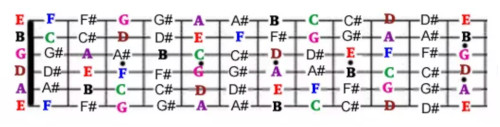
The whole fretboard at a glance. Once you know the patterns, every note has its place.
Knowing the fretboard is like having a map instead of wandering in the dark. The best part? You do not need to memorize all 72+ note positions like flashcards. You only need to understand a few repeating patterns, and the rest falls into place.Step 1 — The Musical Alphabet
Only Seven Letters (Plus the Gaps)
Music uses just seven letters: A B C D E F G, and then it repeats. Between most of them there is a sharp/flat note (a "half step"), except for two special gaps you must remember:• There is no note between B and C.
• There is no note between E and F.
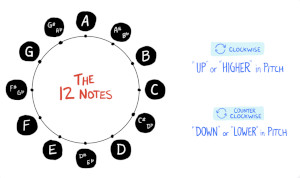
The musical alphabet. Notice the two gaps: there is no note between B and C, or between E and F.
On the guitar, one fret = one half step. So if you know one note, the next fret up is simply the next step in the alphabet. Learn those two gaps and you already know how the whole neck is spaced.🎸 Practice This in Guitar Scales & Chords App


The Fastest Way to Drill the Fretboard
Reading about the fretboard is one thing — but you learn it by doing. The Guitar Scales & Chords app has an interactive Fretboard Notes exercise built for exactly this. With over 2 million downloads and a 4.6-star average, it is one of the most trusted ways to truly learn the neck.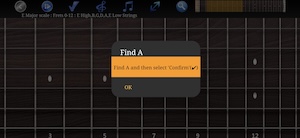
The app names a note and you tap it on the fretboard — choose exactly which strings, frets and keys to focus on so you learn efficiently.
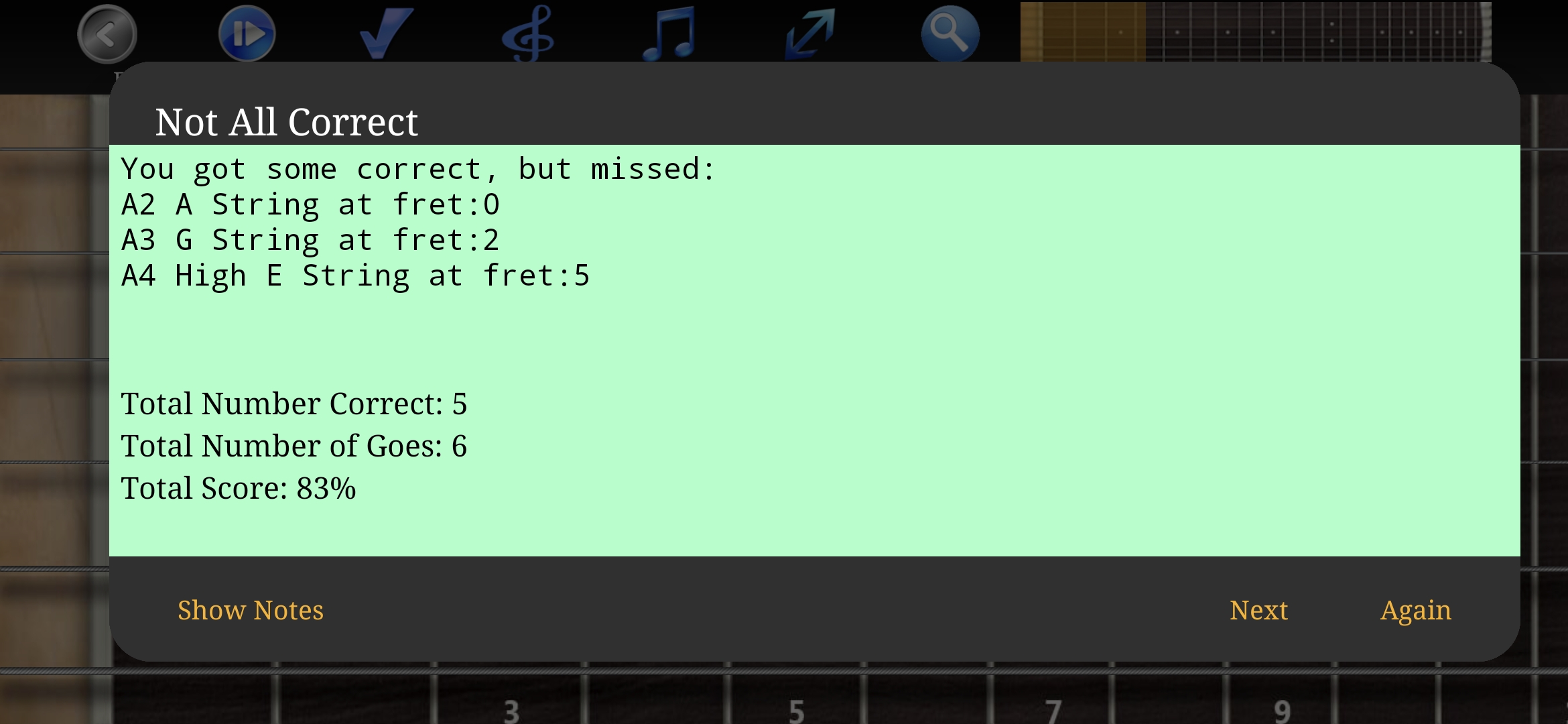
The app will tell you how many you got correct and you can see where all the correct ones were.
Step 2 — Anchor on the Open Strings
Start From What You Already Know
You already half-know the fretboard: the six open strings. From thickest to thinnest they are E A D G B E. A classic way to remember them is "Eddie Ate Dynamite, Good Bye Eddie." These six notes are your anchor points — every fretted note is just counted up the alphabet from the open string.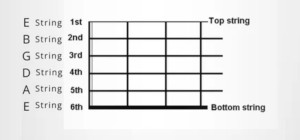
The six open strings — E A D G B E — are your anchor points for everything else.
Start one string at a time. Say the open string name, then walk up: open E → F (1st fret, remember the E-F gap!) → F# (2nd) → G (3rd), and so on. Do just one string a day and the neck stops being a mystery.Step 3 — Use Landmark Frets
Let the Dots Do the Work
Your guitar already gives you signposts: the inlay dots at frets 3, 5, 7, 9 and the double dot at 12. Instead of memorizing every fret, memorize just the notes at the dots first. They act as reference points you can count from in either direction.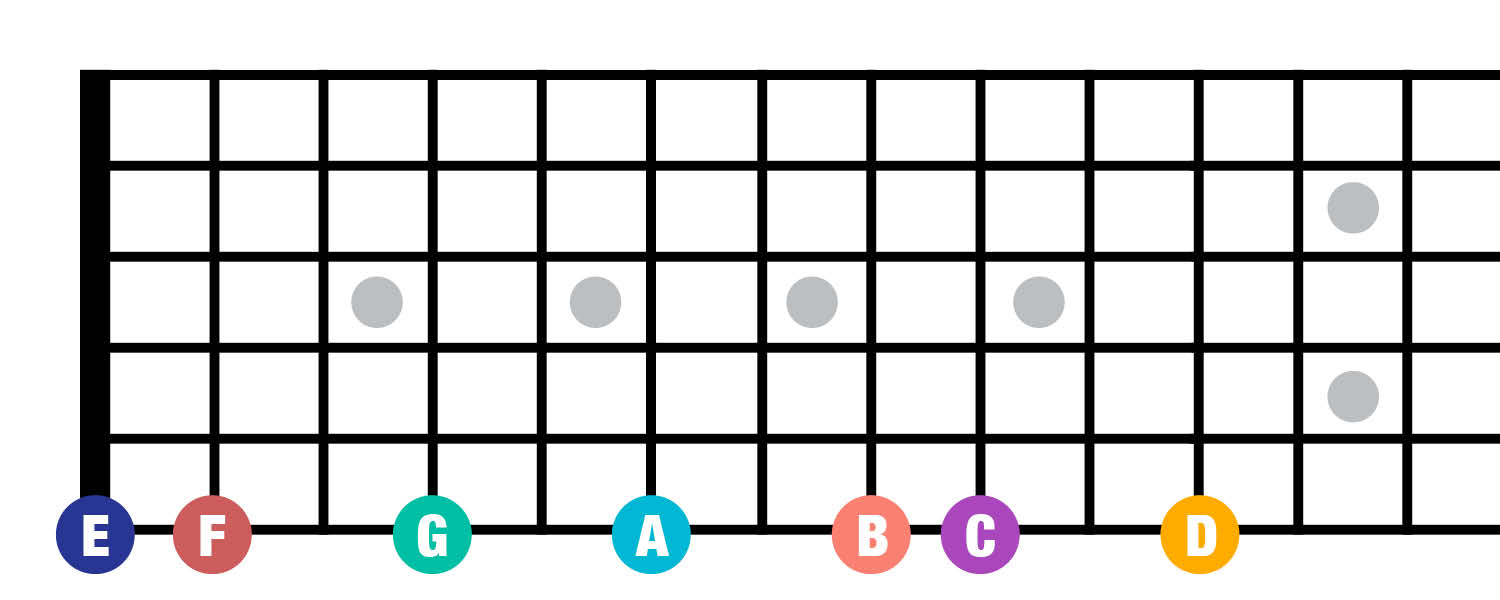
The inlay dots at frets 3, 5, 7, 9 and 12 make perfect landmarks to count from.
For example, the 5th fret of the low E string is A, and the 5th fret of the A string is D. Learn a handful of these "dot notes" and you can always find your way home, then count one or two frets to whatever you need.Step 4 — The Octave Shapes Trick
Learn One Note, Get Two for Free
This is the secret that replaces memorizing charts. The same note appears all over the neck, and there are simple octave shapes that connect them. Learn a note on the low E string and you instantly know the same note two strings up and two frets across — that's the octave.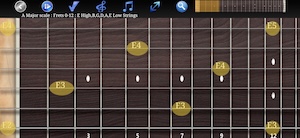
Octave shapes let you find the same note all over the neck — learn one, get the rest for free.
So you never really memorize 72 separate notes. You learn the low two strings well, then use octave shapes to find the same note anywhere else. At the 12th fret everything repeats — the notes are exactly the same as the open strings, just an octave higher.Step 5 — Naturals First
Ignore the Sharps and Flats at First
There are only seven natural notes (A B C D E F G). Learn just those across the neck and you've done 90% of the work — every sharp and flat is simply one fret either side of a natural note. Trying to learn all twelve notes at once is what makes people give up.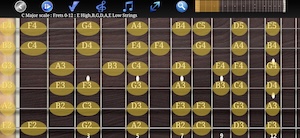
Learn just the seven natural notes first — the sharps and flats sit one fret either side.
Once the naturals feel automatic, the sharps and flats need almost no extra effort — you already know where they live.Step 6 — Say It Out Loud
Active Recall Beats Staring at Charts
Charts let your eyes do the work while your memory stays asleep. Instead, point at a random fret and say the note name out loud before you check. This "active recall" is how the brain actually builds lasting memory. Getting it slightly wrong and correcting yourself teaches you far more than re-reading a diagram.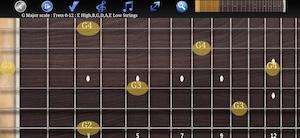
Point at a random fret and say the note out loud before you check — active recall sticks.
A great drill: pick one note (say "G") and find every G on the neck, saying each one aloud. Then pick another. This is exactly the kind of practice an app can quiz you on automatically.Step 7 — Little and Often
Five Minutes a Day Wins
The fretboard is learned through repetition spread over time, not one long cram session. Five focused minutes a day — naming notes, walking a string, finding octaves — will beat a two-hour marathon every time. Within a few weeks the neck will feel familiar instead of frightening.
Five focused minutes a day beats one long cram session every time.
Quick Recap
• Learn the musical alphabet and the B-C / E-F gaps.
• Anchor on the open strings and the dot frets.
• Use octave shapes instead of memorizing every note.
• Naturals first, then sharps and flats.
• Say notes out loud, a few minutes every day.
Do this and you'll never need to stare at a fretboard chart again — you'll just know the neck. The quickest way to lock it in is to drill it interactively in Guitar Scales & Chords.
Share This Article


